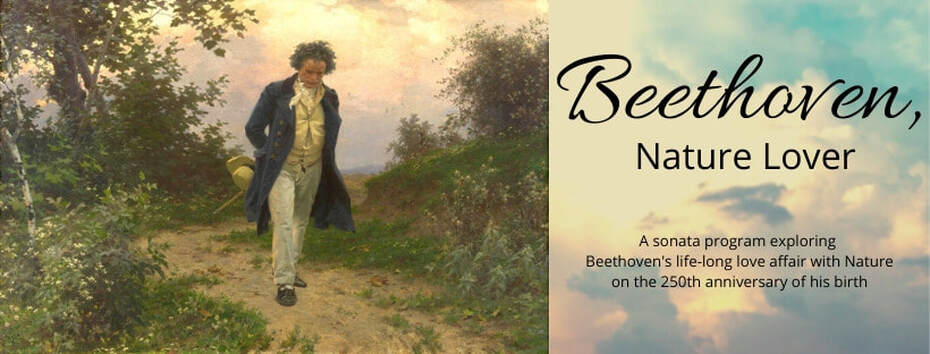
"How happy I am to be able to wander among bushes and herbs, under trees and over rocks; no man can love the country as I love it."
Ludwig van Beethoven (1770 - 1827), in a letter to Baroness von Drossdick
Beethoven’s life-long ardor for nature outlasted every other love he had. One of my favourite stories about Beethoven's childhood is that his family's home on the Rheingasse in Bonn had two telescopes positioned by the attic windows where he and his brothers played and looked out over a landscape stretching twenty miles on clear days. I love the image of little Ludwig at a telescope, looking for the most distant point possible and then trying to go further yet - a fitting metaphor for his life's work.
As a boy, Ludwig and his father took long excursions together into the countryside, that sometimes lasted several days. They hiked rugged hills, walked through leafy woods, climbed dark slate outcrops, gazed down deep gorges, and felt the raw power of the Rhine. Later in life, Beethoven nostalgically recalled the “mysterious fir forests” and the “sweet stillness of the woods” he longed to return to, declaring “I never feel entirely well except when I am among scenes of unspoilt nature”. During hot, dusty Viennese summers he fled to the countryside and dreamed of buying a small house there. As his encroaching deafness made communication with people increasingly difficult, he spent hours tramping across fields alone, compositional notebook in hand. Charles Neate, an English pianist who sometimes accompanied Beethoven on long walks, noted that he had never met anyone “who so delighted in Nature or so thoroughly enjoyed flower or clouds or other natural objects”. His Viennese friends tell us that Beethoven, who frequently moved lodgings within the city, refused to live in a home unless there were trees nearby, and that he insisted on daily walks even in torrential rain. Beethoven’s interactions with nature provided the relief, inspiration, and comfort that he so often found lacking in social settings.
However, Beethoven's relationship with nature was not just picturesque; it could also be terrifying. In 1784 his family’s home on the Rheingasse in Bonn was flooded as the great Ice Floods overwhelmed the region, and the 13-year-old Beethoven made a perilous escape across neighbouring rooftops. In 1816, much of Europe experienced the “year without a summer” following the eruption of Mt. Tambora in Indonesia, resulting in failed crops and widespread food shortages. While Beethoven certainly experienced moments of rhapsodic outbursts ("Who can give complete expression to the ecstasy of the woods!", he once exclaimed), he was too clear-eyed to accept the aristocrats' romanticized view of rural life as one of quaint simplicity. Their vacuous tropes, which equated retreat from the material world with a corresponding quality of inner life, were foreign to him. While 18th century nobility built imitation hameaux and played at pastoral clichés, Beethoven squelched through mud, wiped rivulets of rain from his face, and tramped long miles until every muscle ached.
It is therefore no surprise that Beethoven's music mirrors a natural world defined by struggle, resilience, and survival. His musical language is imbued with the immense effort that underlies every step forward, opening the door to profound inner exploration. On the cover of the first edition of his Pastoral Symphony is the inscription Mehr Ausdruck der Empfindung als Malerei ("an expression of feeling rather than a painting"). Beethoven asks us not to fixate on literal images of nature, but on the elevated emotional response they awaken within us. We can only imagine what thoughts accompanied him on his long walks, but we feel the sheer immensity of his inner life in his words, “In the country it seems as if every tree said to me: ‘Holy! Holy!"
The descriptive titles of the three sonatas on this program were all added by Beethoven's editors, inspired by the unmistakable outdoor allusions: cuckoo calls and rustic country dances in Op. 79, a bagpipe drone in Op. 28; and bucolic hunting horns in Op. 31, no. 3.
When I first learned these sonatas as a child, I was instantly charmed by the birdsong and the dance rhythms (and I loved playing the leaping "cuckoo" figures as fast I could, in defiance of my teacher's protests). Over the years, however, I've grown to realize that the true magic of these works lies far beyond literal depictions of nature. Beethoven takes these rustic elements and transfigures them into a resonant, universal language that speaks directly to our innermost being, revealing fresh wonders with every replaying.
Sonata Op. 79, "Cuckoo" (1809)
Sonata Op. 28, "Pastoral" (1801)
Sonata Op. 31, no. 3, "The Hunt" (1802)